Institutional records serve purposes far beyond passive historical preservation. They document identity, provide vital context for research, foster lasting alumni engagement, and preserve irreplaceable knowledge that informs strategic planning. For modern high schools, preserving this legacy is no longer about tucking printed volumes away on dusty library shelves. Instead, adopting modern solutions to digitize yearbooks and create an accessible digital archive turns dormant memories into active community assets.
This comprehensive guide examines how institutions can protect fragile records, modernize their yearbook collection, and implement interactive platforms that celebrate school history every single day.
The Critical Need for Preserving School History
Before establishing an archival program, understanding the immediate risks facing historical materials, such as those found in old high school yearbooks, clarifies why this work demands urgent attention.
Physical Materials Face Rapid Deterioration
Paper-based records are highly vulnerable to environmental factors, repeated handling, and natural aging. Standard print photographs often experience notable decay after several decades, while acidic newsprint and paper stocks degrade even faster, highlighting the need for effective online archives to preserve school memories. High schools established in the early-to-mid 20th century now face critical preservation deadlines as early volumes of school yearbooks reach their structural limits.
Decades of historical records stored in unregulated basements or attics suffer from humidity, temperature fluctuations, and pest damage. Brittle yearbook pages, failing bindings, faded ink, and deteriorating photograph emulsions mean that every unmanaged year risks permanent loss. Once paper fibers crack and color dyes vanish, even professional conservation cannot completely restore the original media.
Digital-Born Records Introduce New Vulnerabilities
While older items face biological and chemical decay, modern school years generate vast quantities of born-digital assets. Digital photographs, video recordings of performances, website announcements, and student publications rarely exist on physical paper.
Without intentional curation, digital files are vulnerable to storage hardware failures, format obsolescence, and lost passwords. High schools that assume modern hard drives automatically preserve records often discover that outdated file formats or decentralized storage make retrieval impossible just a decade later, emphasizing the need for effective yearbook scanning. Implementing digital preservation standards ensures that both vintage and modern materials, such as old high school yearbooks, survive into the future.
Building a Unified Yearbook Collection: Strategic Planning
A successful archival initiative begins with structured assessment and clear collection guidelines.
Conducting a Comprehensive Inventory
Institutions should start by logging all physical and electronic historical assets across campus. A thorough inventory identifies:
- Complete sets of school yearbooks, noting any missing volumes from specific school years.
- Unbound photography collections, including faculty portraits, club gatherings, sports competitions, and campus construction.
- Student-led journalism, literary magazines, and commencement programs.
- Academic honor rolls, athletic scorebooks, and institutional award records.
- Digital files scattered across administrative drives, shared cloud accounts, and local network folders can be organized into a cohesive online archives system for better accessibility.
Evaluating physical condition during this stage helps high schools prioritize which volumes need immediate intervention. If certain high school yearbook editions are falling apart, those should move directly to the front of the scanning queue.
Defining Scope and Access Policies
Not every paper scrap requires permanent preservation. Clear acquisition policies define what belongs in the institutional repository, including criteria for the inclusion of physical yearbooks and online high school digital archives.
- Core Institutional Records: Official policy documents, leadership minutes, and curriculum milestones are essential components of the historical archives that support school yearbooks collection.
- Student Life Documentation: Including school memories from the past and present in the online archives enhances the value of the collection. Every historical high school yearbook, student newspaper, and graduation roster.
- Community Contributions: Historic memorabilia and family-held photos donated by local supporters contribute to the online high school digital archives.
Institutions should also develop guidelines balancing open community access with privacy protections, ensuring sensitive student administrative records remain restricted while public celebratory materials remain freely browsable.
Modern Digitization: Bringing Fragile Records into the Future
Converting physical artifacts into digital surrogates protects the originals from handling damage while opening unprecedented access across entire school communities.
Non-Destructive Scanning and Preservation Standards
Digitizing bound volumes requires specialized care. Standard flatbed scanners force bindings open at sharp angles, cracking aging glue and tearing fragile paper. Professional capture employs specialized book cradles, overhead cameras, or V-shaped scanning platters that capture complete yearbook pages, margins, and gutters without flattening the spine.
Archival standards generally call for high-resolution captures—typically 600 DPI for photographs and fine illustrations—saved as uncompressed master files, ensuring the preservation of physical yearbooks. From these master copies, compressed derivatives are generated for responsive display across web interfaces and interactive kiosks.
Automated Searchability Through OCR
Capturing raw image scans is only the first step. Running text recognition tools across every yearbook page converts printed typography into a fully searchable database.
Optical Character Recognition (OCR) unlocks the vast value of historical yearbook content. Rather than flipping manually through dozens of separate volumes, users can run a single query to locate every instance of a specific family name, coach, athletic squad, or extracurricular club across an entire century of high school yearbook editions. Comprehensive keyword search transforms static pictures into rich historical reference material.
Managing Metadata for Easy Discovery
Organized digital collections depend on robust metadata, especially when cataloging school yearbooks collection and other historical archives. Tagging each item with date ranges, subject classifications, associated activities, and identified names ensures that incoming queries yield accurate results. A properly structured taxonomy allows a visitor to search not only by year, but by theme—such as drama productions, championship games, or facility renovations—making the entire yearbook collection intuitive to explore.
Interactive Displays: Taking Archives Beyond Passive Storage
For decades, archives remained locked behind closed doors, accessible only to determined researchers or staff members with dedicated keys, but now schools implementing digital can enhance yearbook access for all. Today, implementing digital displays allows institutions to bring their heritage directly into daily campus life, including showcasing the school yearbooks collection.
Dynamic Campus Experiences
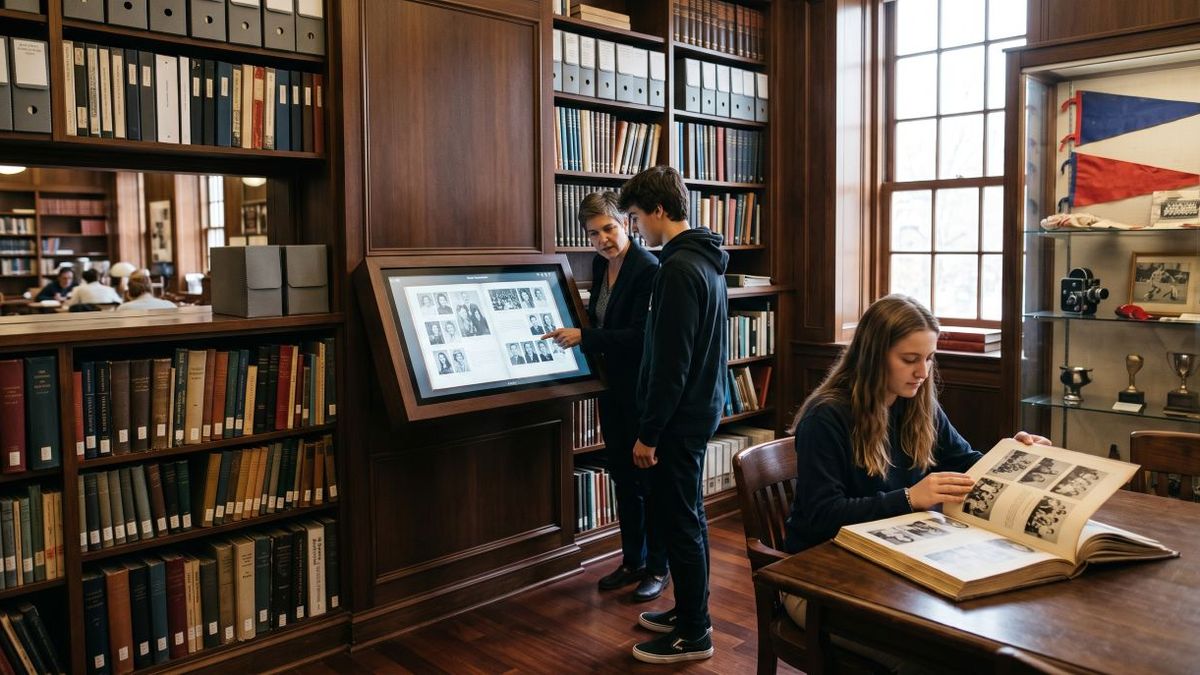
Mounting commercial-grade interactive touchscreens in prominent locations—such as main entryways, athletic concourses, libraries, and performing arts lobbies—transforms passive historical records into engaging public encounters.
Rather than walking past crowded, static trophy cabinets, visitors, students, and faculty can step up to an intuitive touchscreen to explore decades of high school yearbook entries, video highlights, and championship rosters. Research shows that community members spend significantly more time interacting with engaging digital installations than glance-viewing traditional display cases, forming a tangible emotional bridge between past milestones and modern achievements.
Unifying Recognition and Historical Records
A dynamic touchscreen system easily integrates multiple storytelling initiatives onto a single interface. Schools can display:
- Complete digital yearbook archives organized chronologically by decade.
- Dedicated digital recognition boards celebrating athletic champions, distinguished educators, academic honorees, and generous supporters can be integrated into the online high school digital archives.
- Milestone timelines tracing architectural growth, academic evolutions, and notable traditions.
- Multimedia galleries featuring interviews, campus recordings, and student art.
Combining modern digital recognition with a comprehensive digital archive honors foundational leaders while simultaneously celebrating today’s active student body.
Cloud-Based Management and Broad Community Reach
Modern archival management platforms operate entirely in the cloud, removing the technical burdens that previously challenged institutional IT teams.
Streamlined Administration
Cloud infrastructure eliminates the need for expensive on-premise servers and manual software maintenance. Features essential for ongoing maintenance include
- Anywhere Access: Authorized team members can manage records, upload newly digitized files, and adjust tags from any web browser.
- Unlimited Scalability: The potential for expanding online high school digital archives ensures that future generations can access school memories and historical archives. Cloud storage expands effortlessly as new volumes of school yearbooks, event photography, and student publications are cataloged each term.
- Continuous Backups: Automated redundant backups protect historical assets against local equipment failures or accidental deletion.
- Role-Based Permissions: Administrators can grant targeted editing rights to library staff, student interns, or volunteer historians without risking system security.
Web-Accessible Portals for Wider Engagement
While physical touchscreens anchor campus engagement, modern systems simultaneously mirror digital collections online. Providing authorized online access allows alumni living across the globe to browse their own high school yearbook, rediscover forgotten campus moments, and share milestone clippings with their families.
Many institutions also collaborate with local historical groups and public libraries to cross-index historical materials, ensuring the broader town or regional community can explore shared cultural history.
Specialized Focus: Unlocking the Value of Yearbooks
Among all school records, none capture the authentic spirit of an era quite like the yearbook.
What Makes Yearbook Content Unique
Unlike formal administrative board notes, each annual yearbook reflects the spontaneous humor, slang, fashion, and social bonds of the student body. Every single yearbook photo serves as an essential demographic snapshot of an institution's culture during that exact school year.
Preserving a comprehensive digital yearbook library safeguards:
- Complete class rosters and individual student portraits.
- Extracurricular club activities and seasonal theater programs.
- Comprehensive team records, starting lineups, and game summaries.
- Candid snapshots detailing campus life, study halls, and community traditions.
When institutions digitize yearbooks, they unlock these personal narratives, making it effortless for alumni committees to organize milestone reunions, build retrospective presentations, and reconnect disconnected graduating classes.
Sustaining the Archive: Creating an Active Historical Pipeline
Archiving is not a one-off project; it requires ongoing care to ensure future years do not become historical blind spots.
Annual Ingestion Routines
Institutions should establish concrete workflows to archive each graduating class's output immediately:
- Secure pristine digital print files of every newly produced high school yearbook directly from the publishing company.
- Ingest high-resolution raw photography from official campus events, award assemblies, and athletic seasons.
- Archive full electronic runs of student newspapers, literary magazines, and athletic programs.
- Back up administrative milestone announcements, building master plans, and accreditation findings.
Ingesting materials annually while they are still in active circulation eliminates future scanning backlogs and guarantees that the digital archive remains up to date.
Community Crowdsourcing and Collaborative Tagging
Gaps inevitably appear in historical collections, especially for older school years where official copies were damaged or lost. Launching crowdsourcing initiatives invites alumni and neighborhood families to contribute missing editions from their private collections.
Once physical materials are converted into digital files, online crowdsourcing allows alumni to contribute missing names for candid group shots and unindexed team photos. Turning preservation into a collaborative, community-wide initiative fosters shared pride and uncovers details that formal institutional paperwork never captured.
Connecting Past and Future Through Digital Preservation
Every educational community possesses a story worth sharing. When institutions invest in modern preservation, convert fragile collections into searchable digital assets, and showcase those achievements through vibrant campus displays, they accomplish far more than simple record-keeping.
A well-maintained digital archive bridges the past and the future. It instills pride in current students, honors the hard work of prior generations, and ensures that an institution’s distinct legacy remains visible, accessible, and celebrated for decades to come.