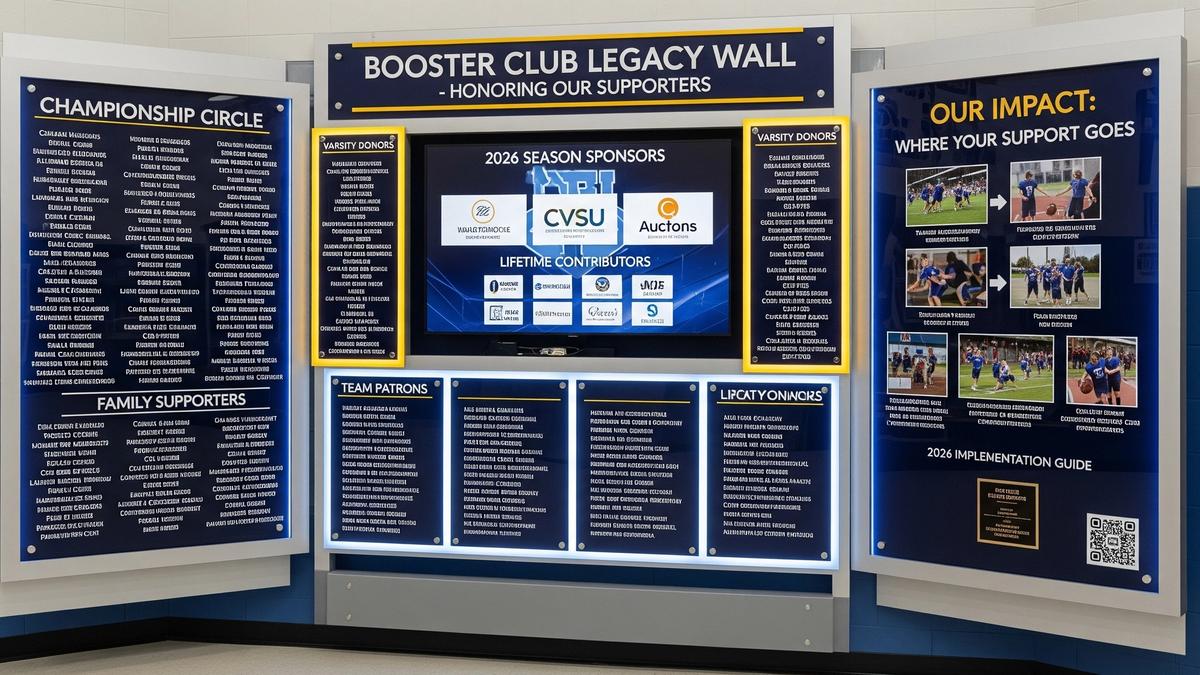
Athletic booster clubs serve as the financial backbone of youth and school sports programs, raising funds for equipment, facility improvements, travel expenses, and opportunities beyond standard school budgets. Properly acknowledging donors, sponsors, and contributing families through custom recognition builds lasting relationships, ensures transparency, and motivates ongoing support. However, many booster organizations face recognition challenges—from space-limited plaques to outdated displays that fail to reflect current contributors.
This guide explores effective donor recognition strategies for booster clubs, examining traditional versus modern digital approaches, key features to consider, budget planning, and proven methods for celebrating the supporters who enable athletic excellence.
The Strategic Value of Donor Recognition for Booster Clubs
Athletic booster clubs operate in distinctive fundraising environments where recognition serves multiple strategic functions beyond simple thank-you gestures. Understanding these purposes helps organizations design programs that deliver meaningful value.
Cultivating Long-Term Supporter Relationships
Fundraising research demonstrates that recognition quality significantly influences donor retention. Contributors who feel genuinely valued tend to give more frequently and at increased levels over time, especially when they see their names on recognition plaques. For booster clubs running annual campaigns, this retention proves invaluable—maintaining existing supporters requires substantially less effort than constantly recruiting new ones.
Strategic donor recognition transforms occasional contributors into committed partners by:
- Demonstrating genuine appreciation for their support
- Illustrating exactly how contributions are utilized on a digital donor recognition wall.
- Creating visible community presence that honors generosity
When supporters see their names displayed prominently alongside explanations of gift impact, they develop stronger program connections and motivation for continued involvement.
Establishing Financial Transparency
Booster clubs often manage substantial budgets, sometimes handling six-figure annual revenues from numerous small gifts and major sponsorships. Public recognition that acknowledges every contributor establishes crucial accountability by revealing exactly who supports programs and at what levels.
This transparency builds confidence among current donors that funds serve stated purposes rather than vanishing into unclear processes. It also strengthens relationships with school administrations and athletic departments requiring assurance that booster operations maintain proper financial practices and community backing.
Motivating Additional Contributions
Visible recognition creates positive social influence that encourages broader participation. When families observe neighbors, local businesses, and community members listed as supporters, they feel motivated to contribute so their names appear among others investing in student athletes. Recognition displays effectively communicate participation expectations—showing that booster support represents normal community involvement rather than optional charity.
Strategic recognition also creates aspiration toward increased giving. Donors at modest levels see benefits associated with premium sponsor tiers and may consider upgrading to access enhanced recognition. Businesses notice competitor visibility and seek comparable or superior placement, creating healthy competition that boosts overall fundraising results.
Building Community Identity
Athletic programs foster community identity around shared pride in student achievement. Recognition displays transform individual contributions into collective celebration by showcasing the extensive support network that makes programs possible. When visitors see dozens or hundreds of names representing families, businesses, and alumni, they understand that programs succeed through widespread commitment rather than isolated efforts.
This collective celebration particularly resonates in communities where athletics serve as primary sources of local pride. Recognition that visibly demonstrates community investment strengthens bonds between schools and the constituencies they serve.
Traditional Recognition Methods for Booster Clubs
Booster clubs have historically acknowledged donors through various physical display approaches, each with particular characteristics, expenses, and constraints.
Engraved Plaques and Recognition Walls
Permanent plaques mounted on walls or display boards represent the most prevalent traditional method. Clubs typically install these in athletic facilities, gymnasiums, fieldhouses, or main school entrances where athletes, families, and visitors regularly see them.
Implementation:
Organizations commission recognition walls with individual brass, aluminum, or acrylic plaques engraved with donor names and contribution tiers. Larger installations include header plaques identifying levels like Platinum Sponsors, Gold Contributors, or Supporting Families. Some designs incorporate school logos, mascots, or decorative elements creating branded recognition zones on interactive donor displays.
Cost Structure:
Individual plaques typically cost $30-$150 based on size, material, and engraving complexity. Complete wall installations with mounting systems range from $2,000-$15,000 depending on scale and quality. Ongoing annual additions cost $500-$3,000 as new donors require additional plaques and installation.
Advantages:
- Permanent, formal recognition conveying importance and prestige
- Professional appearance when properly designed and maintained
- One-time investment per plaque without technology expenses
- Familiar format donors understand and appreciate
- Durable materials lasting decades with minimal maintenance
Significant Limitations of traditional donor walls:
- Fixed capacity creating space constraints as donor lists expand
- High recurring costs for annual plaque additions
- Cannot showcase contribution details beyond names and levels on traditional wall designs.
- Difficult updates when donor information changes
- No capability for recognizing in-kind donations or volunteer contributions
- Static display providing no context about fund utilization compared to digital donor recognition walls.
- Limited visual appeal failing to engage younger, digitally-oriented audiences
Printed Banners and Signage
Some clubs recognize major sponsors through vinyl banners displayed at athletic facilities, fields, or gymnasiums. This approach works particularly well for business sponsors seeking brand visibility during games and events.
Implementation:
Clubs design banners featuring sponsor logos, company names, and sometimes contribution levels. Banners display on fences, gymnasium walls, press boxes, or specialized banner systems at athletic venues.
Cost Structure:
Professional vinyl banners cost $100-$500 each depending on size and design complexity. Banner hardware and installation add $200-$1,000. Banners require replacement every 2-4 years due to weather damage and fading, creating recurring expenses.
Advantages:
- High visibility during games when attendance peaks
- Larger format creating impact for sponsors
- Relatively affordable for business sponsors seeking advertising value
- Quick production and installation timelines
- Effective for recognizing current-year sponsors at specific venues
Limitations:
- Weather exposure causing deterioration requiring frequent replacement
- Informal appearance sometimes perceived as less prestigious
- Limited information capacity beyond names and logos
- No recognition for smaller individual donors
- Seasonal display constraints
- Visual clutter when multiple banners compete for attention
Recognition Programs and Printed Materials
Clubs commonly acknowledge donors in printed programs sold at games, distributed at season-opening events, or mailed to supporters. This approach provides detailed recognition without physical display constraints.
Implementation:
Programs include donor sections listing contributors by level, often with business advertisements providing additional revenue. Clubs typically produce annual programs reflecting current-year support.
Cost Structure:
Program design and printing costs $500-$3,000 for 500-2,000 copies depending on page count, paper quality, and color printing. Programs represent annual recurring expenses.
Advantages:
- Unlimited capacity for listing all donors regardless of level on a digital wall.
- Ability to include detailed acknowledgments and sponsor advertisements
- Distribution reaches event attendees
- Revenue opportunity through paid business advertisements
- Flexibility to recognize various contribution types
Limitations:
- Temporary recognition lasting only current season
- Limited reach beyond event attendees
- Minimal lasting visibility once programs are discarded
- No public display creating community visibility
- Production timeline constraints limiting flexibility
- Environmental concerns about single-use publications
Digital Donor Recognition Displays for Booster Clubs
Modern digital recognition platforms address traditional limitations while providing capabilities impossible with physical displays. These solutions particularly suit booster clubs managing growing donor bases, frequent updates, and diverse recognition needs.
How Digital Recognition Systems Work
Digital donor recognition combines commercial-grade display hardware with cloud-based content management software designed for celebrating supporters. Athletic departments, booster clubs, or advancement teams update content through intuitive web dashboards, publishing changes instantly to physical touchscreen displays and companion websites.
Leading digital recognition platforms for booster clubs provide interactive digital displays that enhance donor engagement.
Unlimited Recognition Capacity: Single displays showcase hundreds or thousands of donors without physical space constraints. Clubs recognize every contributor regardless of donation size rather than limiting displays to major sponsors only.
Rich Supporter Profiles: Beyond names and contribution levels, digital displays include business logos, detailed acknowledgments, links to sponsor websites or social media, photos from funded programs, and specific information about donation impact.
Flexible Organization: Content organizes by contribution level, donor type (individuals, families, businesses), specific programs funded (football, basketball, facilities), recognition years, or custom categories matching club structures.
Dynamic Content Updates: Clubs instantly add new donors, update contribution levels, recognize renewed support, and refresh content without fabrication delays or installation costs. This enables real-time recognition during campaigns.
Impact Storytelling: Displays connect donations to outcomes by showcasing equipment purchased, facilities improved, championships won, or opportunities provided—demonstrating tangible results from supporter generosity.
Interactive Exploration: Touchscreen capabilities let visitors search for specific donors, filter by contribution type, explore business sponsors, and discover detailed information about how support gets used.
Essential Platform Features for Booster Clubs
When evaluating digital donor recognition solutions, booster clubs should prioritize features specifically supporting fundraising programs and supporter relationships.
Tiered Recognition Management: Platforms must handle multiple contribution levels with distinct visual presentation—major sponsors receiving premium placement and enhanced profiles while smaller contributors receive appropriate acknowledgment.
Business Sponsor Integration: Business supporters often seek brand visibility as sponsorship return. Effective platforms prominently display company logos, link to business websites or social media, showcase advertisements or promotional content, and provide metrics showing sponsor exposure.
Recurring Donor Tracking: Many booster donors contribute annually over multiple years. Recognition should highlight loyal supporters through multi-year designations, cumulative giving totals, and special recognition for sustained support.
Campaign Progress Visualization: Real-time fundraising thermometers, goal trackers, and progress indicators create urgency during campaigns while celebrating achievements. These features work particularly well for capital campaigns funding specific projects.
Easy Bulk Import: Clubs managing hundreds of donors need efficient data entry. Quality platforms provide spreadsheet upload capabilities and automated processing eliminating manual profile creation.
Web-Accessible Recognition: Beyond physical displays, recognition extends to online donor walls accessible from anywhere. This expands visibility, enables social media sharing, and provides links clubs can include in email campaigns and newsletters.
Flexible Display Options: Booster clubs operate in varied environments from gymnasiums to outdoor facilities, utilizing wall ideas for effective donor recognition. Recognition platforms should work across multiple contexts: large touchscreen displays in athletic facilities, smaller displays in trophy cases, web browsers for online access, and projection systems for events.
Detailed Analytics: Understanding donor engagement helps refine recognition strategies. Analytics revealing which sponsors get viewed most, how long visitors explore content, and when engagement peaks inform decisions about content promotion and display placement.

Comparing Digital Recognition Vendors
Several vendor categories serve booster club recognition needs, each with distinct strengths and appropriate applications.
Purpose-Built Donor Recognition Platforms
Solutions like Touchstone Digital Solutions specialize exclusively in recognition and supporter celebration. These platforms combine sophisticated donor management features with touchscreen-optimized interfaces designed specifically for public display environments. Purpose-built platforms typically provide complete solutions including software, hardware recommendations, implementation support, and ongoing assistance.
Benefits: Recognition-specific features addressing unique requirements, intuitive management requiring minimal training, dedicated support teams understanding fundraising context, proven reliability across numerous implementations, and faster deployment with pre-configured templates.
Considerations: Higher investment than basic slideshow tools and subscription models creating ongoing costs.
Digital Signage Adapted for Donor Recognition
Campus communication platforms can display donor lists as part of broader signage systems. These work when schools already use such platforms for announcements and communications.
Benefits: Multi-purpose investment supporting various needs and existing familiarity if already deployed campus-wide.
Limitations: Minimal database functionality, basic interactivity not optimized for deep donor exploration, generic templates not tailored to fundraising, and limited search or discovery features.
Custom Development
Organizations with significant budgets sometimes commission custom donor recognition websites integrated into existing school platforms. This approach provides unlimited flexibility but requires substantial investment and technical expertise.
Benefits: Complete design control and deep integration with existing school systems.
Challenges: Substantial development costs ($15,000-$100,000+), extended timelines (6-24 months), ongoing maintenance burden, and variable quality depending on developer capabilities.
Budget Slideshow Solutions
Some clubs create basic donor slideshows using presentation software displayed on consumer televisions. While minimally expensive, these approaches lack database functionality, interactivity, searchability, professional presentation, and scalability—serving only as temporary measures.
Recognition Strategies That Maximize Fundraising Results
How booster clubs structure and implement recognition programs directly impacts fundraising effectiveness. These proven strategies help clubs maximize return on recognition investment.
Designing Effective Contribution Tiers
Thoughtful tier structures guide donors toward giving levels that balance club funding needs with supporter capacity while creating clear upgrade paths.
Establish Meaningful Tier Distinctions
Create 4-6 distinct levels with meaningful gaps between them. Common structures include:
- Leadership Level: $5,000+ for major sponsors and exceptional supporters
- Platinum: $2,500-$4,999 for significant business sponsors
- Gold: $1,000-$2,499 for substantial family or business contributions
- Silver: $500-$999 for meaningful supporter contributions
- Bronze: $250-$499 for solid base-level support
- Friends: Under $250 for broad participation
These ranges should reflect community economic context and program funding needs, adjusted based on local conditions.
Differentiate Recognition Benefits
Each tier receives distinct recognition reflecting contribution significance. Leadership sponsors might receive premium placement, enhanced profiles with business advertisements, recognition at all athletic events, social media promotion, and special acknowledgment in communications. Lower tiers receive appropriate but less prominent recognition, creating clear value progression.
Communicate Tier Value Clearly
Donors need to understand exactly what recognition each level provides. Booster clubs should publish specific benefits: "Gold Sponsors receive prominent display on the digital donor wall with company logo and website link, recognition in game programs, and quarterly social media acknowledgment."
Create Stretch Goals
Consider aspirational tiers above typical giving ranges for exceptional supporters. Facility naming opportunities, dedicated recognition displays, or permanent legacy recognition can attract transformational gifts from highly committed donors or businesses seeking premium visibility.
Timing Recognition Updates Throughout the Year
Strategic update timing keeps recognition current while maximizing fundraising impact during critical campaign periods.
Campaign Launch Recognition: Begin fundraising drives by updating displays to feature current campaign goals, showcase past supporters being invited to renew, highlight new recognition opportunities, and create urgency through progress tracking.
Real-Time Campaign Updates: Throughout major fundraising periods, update displays weekly or even daily to acknowledge new contributors immediately. This rapid recognition rewards early donors, demonstrates campaign progress, and creates social proof encouraging additional participation.
Season Celebration Updates: After successful seasons or championship achievements, update donor recognition to connect support with results achieved. Include championship photos, athlete accomplishments, team achievements, and specific acknowledgment linking contributions to outcomes.
Year-End Recognition: Conclude fundraising years by publishing comprehensive donor lists, celebrating total amounts raised, showcasing cumulative impact across all programs, and thanking supporters with detailed acknowledgment.
Off-Season Maintenance: Use quieter periods to refine content, add photos and details to existing profiles, organize categories for easier navigation, and prepare infrastructure for upcoming campaigns.
Integrating Recognition with Broader Booster Operations
Recognition works best when integrated throughout booster club activities rather than treated as isolated display management.
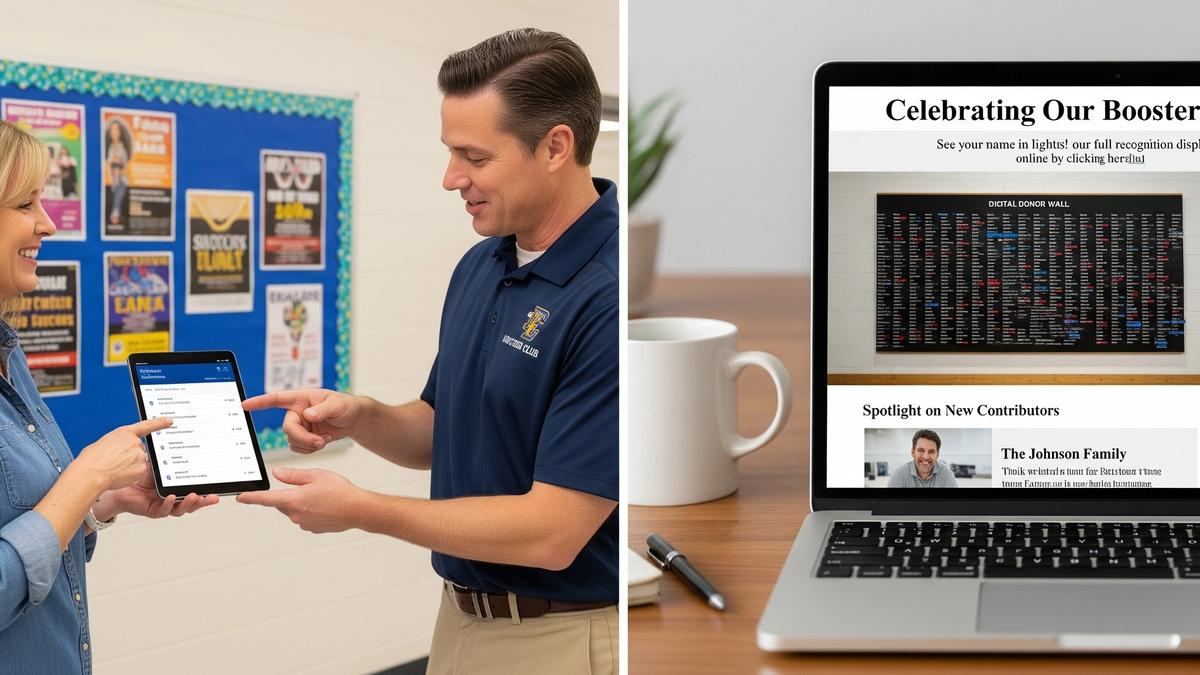
Connect Recognition to Fundraising Asks: When soliciting contributions, show donors exactly where their recognition will appear. Include photos of existing displays, links to online donor walls, or demonstrations of digital platforms.
Feature Recognition in Communications: Regular newsletters, social media posts, and email campaigns should showcase the donor wall, highlight new contributors, celebrate giving milestones, and direct supporters to explore full recognition displays online.
Create Recognition Events: Host annual donor appreciation events where supporters gather in front of recognition displays for acknowledgment, program updates, and celebration.
Leverage Recognition for Recruiting: When recruiting new supporters, show them physical displays or online donor walls as proof of broad community support. Demonstrating that numerous others contribute creates normative encouragement for participation.
Involve Athletes in Recognition through interactive digital displays to enhance engagement. Student athletes should understand who supports their programs and express gratitude accordingly. Consider having teams record thank-you videos displayed on recognition platforms, having athletes present at donor events, or creating athlete-generated social media content acknowledging support.
Implementation Guide: Launching Digital Donor Recognition
Successful implementation requires systematic planning and execution across several phases.
Phase 1: Planning and Decision Making
Assess Current Recognition: Document existing donor recognition methods, identify limitations and pain points, survey donors about recognition preferences, and determine what's working well that should be retained.
Define Requirements: Clarify specific needs your recognition program must address: number of donors to recognize, types of contributions to acknowledge, display locations and environments, staff capabilities for content management, and budget constraints.
Research Solutions: Evaluate options across categories discussed earlier. Request demonstrations from top candidates, speak with existing customers at similar organizations, review case examples, and compare pricing structures.For schools also interested in athletic achievement recognition, integrated platforms like those featured in digital hall of fame guides provide combined donor and achievement recognition capabilities.
Secure Approval and Funding: Present findings to booster club boards, school administrations, or athletic departments as required. Build business cases showing recognition program value, cost comparisons with current approaches, projected return on investment through improved donor retention, and implementation timelines.
Phase 2: Data Preparation and Content Development
Compile Donor Information for wall displays: Gather complete donor lists including names, contribution levels, contribution years, business information for sponsors, contact details, and preferences for how they want recognition to appear.
Organize by Category: Structure information according to your recognition framework: contribution tiers, individual versus business supporters, specific programs funded, recognition years, or other organizing principles.
Collect Supporting Media: Gather business logos from sponsors, photos showing program impact, team achievement images, facility improvement documentation, athlete recognition photos, and other visual content enriching donor recognition.
Define Profile Standards: Establish consistent guidelines for what information each donor profile includes, ensuring comparable recognition across traditional wall designs and similar contribution levels.
Review for Accuracy: Verify names spelled correctly, ensure contribution levels reflect accurate amounts, confirm business information remains current, and validate that donor preferences get respected.
Phase 3: Hardware Setup and Software Configuration
Select Display Location for donor recognition signs that are visible and impactful. Choose high-traffic areas maximizing visibility: gymnasium lobbies, main athletic building entrances, hallways adjacent to trophy cases, or school main entrances where families gather.
Install Display Hardware: Mount commercial-grade touchscreen displays using appropriate hardware. Ensure proper height for visitor interaction (typically 48-60 inches from floor to center), confirm stable mounting, verify network connectivity, and test touchscreen responsiveness.
Configure Software Platform: Work with vendor implementation teams to set up content management systems, configure contribution tiers and recognition rules, import initial donor data, customize visual design reflecting school branding, and establish user permissions.
Create Initial Content: Build out donor profiles using prepared information, upload media assets, organize content by categories, preview all content before publication, and refine layouts for optimal visual presentation.
Test Thoroughly: Before public launch, verify all touchscreen functions work properly, confirm search and filter capabilities operate correctly, test content on various devices, gather feedback from small test groups, and refine based on findings.
Phase 4: Launch and Ongoing Management
Plan Launch Event: Unveil donor recognition with ceremony acknowledging supporters. Invite major donors, current contributors, school leadership, athletic department staff, team families, and local media.
Promote Actively using modular designs for donor recognition that can be easily updated. Announcement through multiple channels including email newsletters, social media platforms, school website features, athletic department communications, and local media outreach.
Establish Update Workflows: Designate staff responsible for content management, create processes for adding new donors, schedule regular update reviews, define approval procedures, and document common tasks.
Monitor and Optimize: Review analytics identifying popular content, track visitor engagement patterns, gather informal feedback from users, note technical issues, and continuously refine content based on learning.
Maintain Momentum: Prevent recognition from becoming static by adding seasonal content, updating with campaign progress, showcasing new achievements funded by donations, and keeping displays feeling dynamic.
Cost Analysis: Traditional Versus Digital Recognition
Understanding total cost of ownership helps booster clubs make informed investment decisions.
Traditional Plaque-Based Recognition Costs
Initial Installation: $5,000-$20,000 depending on the scale, quality, and design complexity of donor displays. This includes donor wall header, mounting system, initial plaques, professional design services, and installation labor.
Annual Addition Costs: $1,000-$4,000 for new plaques and modular donor levels as the donor base grows, including engraving services, installation labor, and periodic maintenance. These costs recur indefinitely.
Long-Term Limitations: Eventually physical space constraints require difficult decisions about removing old plaques, expanding into additional wall space at significant expense, or ceasing new donor recognition.
10-Year Total Cost: $20,000-$60,000+ when accounting for initial installation plus annual additions and eventual expansion needs.
Digital Recognition Platform Costs
Initial Investment: Setup typically ranges from $10,000-$35,000 depending on display size, feature requirements, content migration needs, and number of installation locations for digital walls. This includes touchscreen display hardware, software platform configuration, implementation support, initial content setup, and staff training.
Annual Subscription: $2,000-$6,000 covering software platform access, cloud hosting, technical support, feature updates, and unlimited content changes. Unlike plaque fabrication costs that increase proportionally with new donors, digital subscriptions remain constant regardless of donor list growth.
10-Year Total Cost: $30,000-$95,000 including initial investment plus subscription fees for interactive digital displays and custom recognition solutions. While potentially higher than minimal plaque installations, digital solutions provide dramatically expanded capability: unlimited donor capacity, rich multimedia content, instant updates, interactive exploration, web accessibility, and analytics impossible with physical plaques.
Break-Even Analysis: Clubs recognizing 100+ donors annually typically reach break-even within 4-6 years as eliminated plaque fabrication costs offset digital subscription fees. Beyond break-even, digital solutions cost less while providing substantially better recognition capabilities.
Hidden Costs to Consider
Staff Time: Traditional recognition requires staff time coordinating plaque orders, managing vendor relationships, scheduling installation, and resolving errors. Digital platforms require initial training investment but then streamline ongoing management.
Opportunity Costs: Traditional displays' limited capacity forces excluding smaller donors or difficult decisions about which supporters receive recognition. These missed recognition opportunities potentially cost thousands in lost future contributions from donors who feel undervalued.
Flexibility Value: Rapid updates enabling real-time campaign recognition, ability to correct errors instantly, and capability to experiment with recognition approaches provide substantial value difficult to quantify financially but meaningful for fundraising effectiveness.
Fundraising Best Practices Using Donor Recognition
Recognition serves as a tool for fundraising success rather than simply acknowledgment obligation. These practices help clubs maximize fundraising results.
Creating Recognition That Motivates Giving
Showcase Impact Visually: Connect donations directly to outcomes by featuring photos of equipment purchased, facilities improved, championship trophies won, or athletes competing. Captions explicitly stating "made possible through generous support from our donors" link contribution to result.
Highlight Donor Stories: Feature detailed profiles of select supporters explaining why they give, what programs mean to their families, or how athletics impacted their lives. These narratives humanize recognition beyond transactional lists.
Recognize Diverse Contribution Types: Beyond monetary donations, acknowledge in-kind contributions like equipment donations, volunteer hours, professional services provided at reduced rates, or event support.
Create Recognition Urgency: During campaigns, display real-time progress toward goals with countdown timers, showcase names being added daily demonstrating momentum, and highlight how close fundraising targets are to achievement.
Leveraging Recognition for Sponsor Recruitment
Demonstrate Visibility Value: When recruiting business sponsors, show analytics demonstrating display traffic, provide visitor engagement metrics proving sponsor exposure, share social media reach, and offer concrete data proving sponsorship delivers meaningful brand visibility.
Offer Tiered Sponsorship Packages: Create structured sponsorship levels with clearly defined benefits at each tier. Premium sponsors receive enhanced recognition (larger logos, featured placement, video content, website links) while base-level sponsors receive appropriate acknowledgment.
Provide Recognition Mockups for custom donor walls: During sponsor recruitment, create visual mockups showing exactly how their recognition will appear on displays. This tangible preview helps businesses visualize sponsorship value.
Enable Sponsor Content Control: Allow business sponsors to update their own profiles, refresh promotional content seasonally, provide special offers to athletic families, or share business news.
Measure and Report Impact: After seasons conclude, provide sponsors with reports documenting display traffic, engagement metrics, social media impressions, and testimonials from families.
Building Multi-Year Donor Loyalty
Recognize Consecutive Giving: Highlight supporters who contribute multiple years consecutively with special designations like "5-Year Champion" or "Decade Partner."
Track Cumulative Contributions: Beyond single-year recognition, acknowledge cumulative lifetime giving. Donors contributing $500 annually for ten years deserve recognition as $5,000+ lifetime supporters.
Create Legacy Recognition: Establish permanent recognition for supporters reaching substantial cumulative giving milestones. "Legacy Circle" or "Heritage Society" designations honoring $25,000+ lifetime contributions provide aspirational goals.
Maintain Historical Recognition: Even as campaigns focus on current-year fundraising, maintain visible acknowledgment of past supporters.
Celebrate Renewal Milestones: When loyal donors renew support, acknowledge renewals specifically rather than treating them identically to new contributors.
Common Challenges and Solutions
Understanding frequent obstacles helps clubs avoid common pitfalls and implement more successful recognition programs.
Challenge: Managing Donor Privacy Preferences
Some supporters wish to contribute anonymously or have specific preferences about how recognition appears.
Solution: Establish clear donor privacy options: full recognition with name and contribution level, recognition with name only, anonymous recognition crediting gift without identifying donor, or completely private contribution. Digital platforms simplify privacy management by allowing donor-specific recognition settings.
Challenge: Keeping Recognition Current
Booster clubs managing multiple fundraising initiatives throughout years face constant recognition updates as new donors contribute, existing supporters increase giving, or businesses renew or discontinue sponsorships.
Solution: Digital recognition platforms fundamentally solve this challenge by enabling instant updates without fabrication delays or installation costs. Establish weekly update rhythms during active campaign periods and monthly reviews during off-seasons.
Challenge: Limited Staff Technical Expertise
Smaller booster clubs often lack dedicated staff with technical skills for managing complex systems.
Solution: Prioritize platforms designed for non-technical users. Quality donor recognition solutions provide intuitive interfaces requiring minimal training—comparable to managing social media profiles. Work with vendors providing strong implementation support and responsive ongoing assistance for custom recognition solutions.
Challenge: Justifying Investment
Booster clubs operate with limited resources where every expenditure requires justification.
Solution: Build business cases demonstrating recognition's return on investment through improved donor retention, increased giving levels, enhanced sponsor recruitment, and reduced ongoing plaque costs. Position recognition investment as fundraising infrastructure that multiplies future campaign effectiveness.
Challenge: Coordinating Multiple Booster Organizations
Large schools sometimes have separate booster clubs for different sports or programs.
Solution: Establish shared recognition infrastructure where practical, with unified displays acknowledging supporters across all programs while allowing filtering by specific sport. Create coordination mechanisms ensuring consistent recognition standards and cooperative fundraising approaches.
Special Considerations for Different Contexts
Recognition strategies should adapt to specific organizational contexts and community characteristics.
Youth Sports Booster Clubs
Youth programs serving elementary and middle school athletes have unique recognition considerations for custom donor walls.
Family-Focused Recognition: Youth programs typically receive support primarily from participating families rather than businesses or alumni. Recognition should celebrate family participation and honor multi-sibling household contributions.
Inclusive Participation Emphasis: Youth programs prioritize broad participation over elite competition. Recognition should celebrate inclusive support enabling all children to participate regardless of family financial capacity through donor displays.
Age-Appropriate Content for digital donor recognition walls: Digital displays should feature content appealing to elementary-age visitors: bright colors, simple navigation, photos showing kids having fun, and celebration of participation and sportsmanship.
Shorter Recognition Timelines: Youth sports experience high turnover as families graduate from programs when children move to middle school. Recognition focuses primarily on current-year supporters, but should also celebrate the history walls of past contributions.
High School Booster Clubs
High school booster clubs generally represent the most established and sophisticated athletic fundraising organizations.
Multi-Generational Recognition: High schools often have alumni spanning 50+ years who continue supporting programs alongside current family supporters. Recognition should honor this continuity by maintaining historical donor acknowledgment.
Alumni Engagement Integration: Recognition can strengthen alumni connections by featuring accomplished former athletes now supporting programs as adult donors.
Multiple Facility Locations: High schools often need recognition in multiple locations: main gymnasium, football stadium, baseball complex, auxiliary gyms, and school main entrance, with wall ideas for effective visibility.
District and Administration Coordination: High school boosters typically operate with school district oversight requiring coordination with administration on significant expenditures or facility modifications.
Travel Team and Club Sports Boosters
Competitive travel teams and club sports organizations outside traditional school structures have distinct recognition contexts.
Program Branding Emphasis through interactive donor displays: Travel teams often prioritize organization branding and reputation within competitive circuits. Recognition should reinforce program identity and showcase competitive achievements.
Family Investment Recognition: Travel sports require substantial family financial commitment beyond participation fees. Recognition should acknowledge families' total investment in programs.
Shorter Organizational History: Many travel organizations operate for only 10-20 years compared to schools with century-long histories. Recognition emphasizes building tradition and organizational identity through interactive digital displays.
Distributed Geographic Communities: Unlike school-based boosters serving defined neighborhoods, travel organizations draw families from wide geographic areas. Recognition should actively build community identity among geographically dispersed supporters.
Future Trends in Booster Club Donor Recognition
Technology and fundraising practices continue evolving, creating new opportunities for donor recognition programs.
Enhanced Mobile Integration: Future recognition platforms will provide deeper mobile experiences enabling supporters to save favorite donors, create personal collections, receive notifications about booster club news, and seamlessly continue exploring recognition beyond physical display interactions.
Social Media Amplification: Easier sharing capabilities will enable donors to share their recognition across social media platforms, creating organic promotion and encouraging peer support.
Artificial Intelligence Applications: AI will assist content creation through automated donor profile generation, intelligent photo organization, personalized visitor experiences, and natural language query support.
Integration with Fundraising Platforms: Tighter integration between recognition systems and fundraising platforms will enable automatic recognition updates as contributions occur, eliminating manual data transfer and ensuring immediate acknowledgment.
Virtual and Augmented Reality Recognition: Emerging technologies may enable virtual recognition wall experiences accessible from home through VR headsets, augmented reality overlays providing recognition information when smartphones scan facilities, and immersive donor appreciation events.
Organizations implementing digital donor recognition today position themselves to adopt emerging capabilities as they mature, while clubs maintaining traditional static displays fall increasingly behind donor expectations for engaging, interactive acknowledgment.
Conclusion: Transforming Support Through Strategic Recognition
Effective donor recognition represents far more than obligatory acknowledgment—it functions as strategic fundraising infrastructure that strengthens supporter relationships, demonstrates program accountability, inspires additional giving, and celebrates community connection sustaining athletic programs. Booster clubs that invest thoughtfully in recognition infrastructure position themselves for long-term fundraising success through enhanced donor retention, improved campaign effectiveness, and stronger community partnerships.
The transition from traditional static displays to interactive digital recognition platforms provides booster clubs with capabilities impossible through physical plaques: unlimited capacity enabling comprehensive supporter acknowledgment, rich multimedia content demonstrating tangible program impact, instant updates keeping recognition current, and interactive exploration creating engaging experiences. While digital solutions require higher initial investment than basic plaques, the combination of long-term cost savings, dramatically expanded functionality, and measurable improvements in fundraising effectiveness consistently delivers strong return on investment.
For athletic booster clubs committed to celebrating supporters who make programs possible, specialized recognition platforms like Touchstone Digital Solutions provide purpose-built capabilities, proven reliability, intuitive management, and comprehensive support enabling successful implementations that serve organizations for years. The recognition infrastructure your booster club implements today will acknowledge generosity, strengthen relationships, and inspire continued support throughout the years ahead.
Ready to transform how your booster club recognizes supporters? Visit Touchstone Digital Solutions to explore complete digital donor recognition platforms designed specifically for athletic fundraising programs and community celebration.